

November 10, 2025
A Privileged Beginning
St. Charles “Carlos” Borromeo was born in 1538 into the pinnacle of Italian society. His father was the wealthy Count of Arona, and his mother hailed from the powerful Medici family, influential bankers and merchants who effectively ruled Florence. Her brother was none other than Pope Pius IV. With such a pedigree, it’s no surprise that Charles was appointed a cardinal and Secretary of State at the tender age of 22. Yet, unlike many of his privileged peers, Charles was drawn to religion from an early age. Much like St. Francis of Assisi centuries before, he had little interest in the wealth and status of his affluent Italian family.
The Right Man for the Times
Charles lived during a tumultuous period when Protestant Reformers argued—often compellingly—that, fifteen centuries after Christ founded the universal Church, human failings had led to corruption and dysfunction within the institution. The Catholic Church’s response was the Counter-Reformation, a movement led by luminaries like St. Ignatius of Loyola, founder of the Jesuits, and St. Charles Borromeo, who worked tirelessly within the system to enact reform.
Thanks to his family connections, Charles was entrusted with immense responsibility at a young age to guide the Church back to its mission. At just 24, he was a civil and canon lawyer, appointed Archbishop of Milan, and tasked with overseeing the largest diocese in Italy, serving over 800,000 Catholics and roughly 3,000 priests. His primary mission was to organize the final session of the Council of Trent and implement its reforms, a monumental task in response to Martin Luther’s critiques.
Reforming the Church
Charles took his role seriously, issuing the first comprehensive Catholic Catechism and demanding that priests adhere to its teachings. He founded and reformed seminaries to provide solid theological training, equipping priests to guide their flocks with the truths of the faith. His legacy endures in institutions like St. Charles Borromeo Seminary in Philadelphia, PA, which culminates its annual 40 Hours Eucharistic Devotion on his feast day, November 4.
Charles insisted that both clergy and laity embrace disciplined lives and pursue genuine interior conversion. He famously instructed priests: “Be sure that you first preach by the way you live. If you don’t, people will notice that you say one thing but live otherwise, and your words will only bring contempt.” Leading by example, Charles prayed and fasted rigorously, even as a young man. His no-nonsense reforms shook the fun-loving, pleasure-oriented culture of Italy, earning him the reputation of someone who, as one commentator put it, “shut down the party.”
Facing Resistance
Not everyone welcomed Charles’s reforms. Legend has it that one religious order, resentful of his crackdown, hired an assassin who fired at the archbishop in his personal chapel. Some disgruntled priests reportedly expressed frustration at the assassin’s poor aim. Undeterred, Charles continued to call for conversion, spiritual integrity, and charity in action, living these principles in his own life.
Heroic Virtue in Crisis
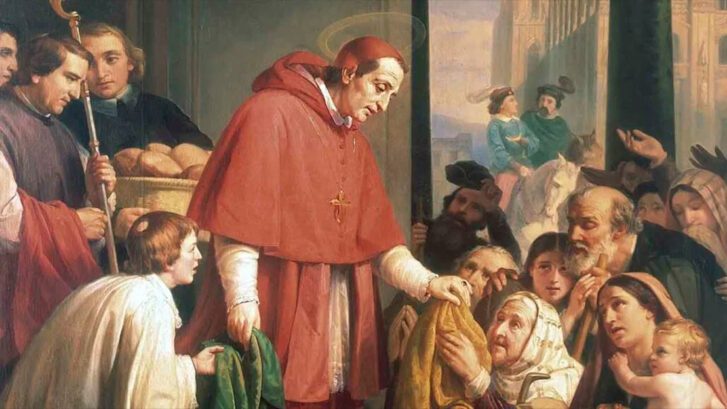
Charles’s commitment to charity shone during the Plague of 1576 in Milan, now known as “the Plague of St. Charles.” He personally ministered to the dying, organized extensive relief efforts, and donated much of his personal and family wealth to feed tens of thousands daily, even going into deep debt to sustain these efforts. To mitigate the spread of disease, he erected outdoor altars for Mass, declaring, “We must give ourselves to the service of God until our last breath. Nothing should be too difficult for us when we remember what Christ has done for us.”
This emphasis on personal moral responsibility was not new but a refreshed theme in Catholic teaching, shifting from abstract ideals to concrete action. In the Pauline tradition, Charles was a minister, teacher, diligent administrator, and passionate exhorter—a true Italian gentleman whose chivalry shone through his self-sacrificing service.
A Lasting Legacy
Worn out by his tireless efforts, Charles died of a fever at age 46 while traveling on his mission. Like St. Carlo Acutis, he drew strength from his deep devotion to the Blessed Sacrament, saying, “Let’s be ever mindful that in this Sacrament lies our strength, our peace, and our love.” St. Charles Borromeo remains the patron saint of catechists, catechumens, reformers, cardinals, bishops, seminarians, and the sick.
His prophetic voice during the Counter-Reformation continues to inspire, reminding us that true reform begins with personal conversion and a life lived in service to God and others.