

Fr. Paschal | July 29, 2025
Today we celebrate three people for whom the Lord had a special love: Martha, Mary, and Lazarus. We’re not told exactly how this familial affection came about—how Our Lord met them or why He came to be at their house so often. And although we’re very familiar with John the Apostle as the beloved disciple, as “the one whom the Lord loved,” this title doesn’t appear in the Gospel of John until after this episode.
In John 11:5, that love is made plain again: “Now Jesus loved Martha and her sister and Lazarus.” Finally, Martha gets a special shout-out—she is named first, while her sister goes unnamed for once. She is loved in her action-oriented spirit. Jesus loved Martha.
Lazarus wasn’t just a “certain man”; he was someone very dear to Jesus of Nazareth. So dear, in fact, that his sisters could send a message saying simply: “He whom you love is ill.” Like Our Lady at the Wedding Feast at Cana, they didn’t offer instructions—just facts. “They have no wine” becomes “He is ill.” Both messages are born of faith in the power of the Incarnate Lord: Mary, the mother of Jesus, believing without seeing that He could provide the best wine—restore joy, so to speak—and Martha and Mary knowing that if Jesus knew, love would prompt Him to act.
It’s in this spirit—perhaps even tinged with disappointment—that Martha speaks frankly to the Lord when He arrives four days too late:
“Lord, if you had been here, my brother would not have died.”
Mary, like in Luke’s Gospel, had stayed indoors. Evidently, she too struggled to understand the Lord’s absence. But in verse 32, after being called by Martha, Mary rises quickly, seeks out the One whom her soul loves, and, weeping, falls at His feet saying the same:
“Lord, if you had been here, my brother would not have died.”
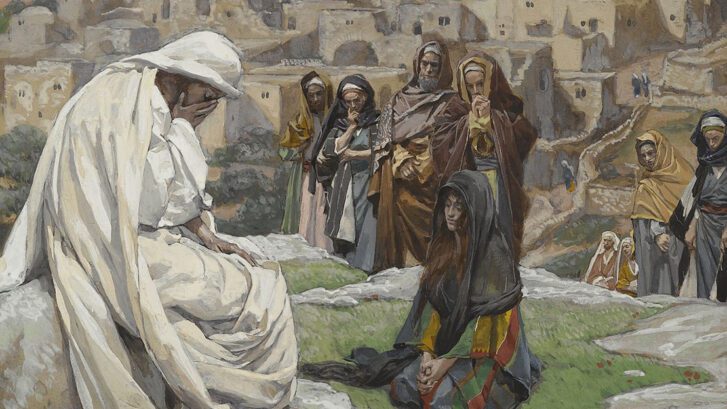
The character of these two sisters is so striking and familiar: Martha, active and dutiful, seems to hold back her tears—there’s work to be done. Mary, contemplative and tender, weeps freely. And Our Lord, deeply moved by their grief, weeps with them.
Now if we step back and think theologically—Jesus is the Incarnate, Divine Lord. Did He have any “need” for friendship? In a strictly theological sense, no. God is completely self-sufficient. He did not create the world out of boredom or lack. God is love—a communion of Persons—and out of the overflow of that love, He created. In His Incarnation, the Word of God—Jesus of Nazareth—being fully human and fully divine, felt deeply this love and the loss that love brings. It is within that same divine-human love that He declares:
“I am the resurrection and the life; whoever believes in me, even if he dies, will live, and anyone who lives and believes in me will never die.”
We thank God today for Martha—for her holy boldness, for her willingness to confront the Lord even when her pain is hard to express. She loves Him deeply and knows she is loved by Him. She loves her brother and knows he, too, was loved by Jesus.
We know this confusion, too—when someone we love dies, and from our human perspective, it seems like the Lord did nothing… that He stayed away. But believe in Him, the Incarnate Lord who weeps with us.
Jesus loves you, and He loves those you love.
See how He loves you.
See how He longs to come to the tombs in your life and call you forth to life again.
See how He loves.