

Fr. Matthew Mary | July 6, 2026
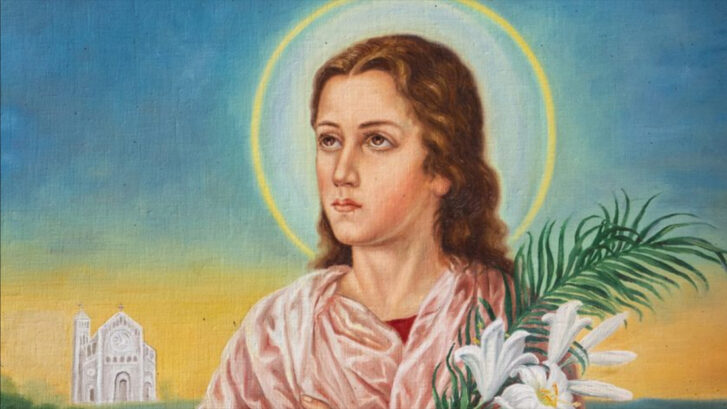
Today the Church celebrates the feast of a remarkable young Italian girl, St. Maria Goretti, Virgin and Martyr, who demonstrated the heroic virtue of a fully grown woman. In his homily for the canonization of this saint, Pope Pius XII says in stark terms: “It is well known how this young girl had to face a bitter struggle with no way to defend herself. Without warning a vicious stranger burst upon her, bent on raping her and destroying her childlike purity. In that moment of crisis she could have spoken to her Redeemer in the words of that classic, The Imitation of Christ: ‘Though tested and plagued by a host of misfortunes, I have no fear so long as your grace is with me. It is my strength, stronger than any adversary; it helps me and gives me guidance.’ With splendid courage she surrendered herself to God and his grace and so gave her life to protect her virginity.”
Not only is Maria Goretti a valiant witness to Christian purity, but also a witness to the mercy of Christ as she chose to forgive her assailant even as he remained unrepentant at the time of her death. Maria exuded the love of Christ throughout her short life on earth and most especially at the hour of her death.
Maria Goretti was born on October 16, 1890, at Corinaldo, a little city near Ancona, and was the third of seven children, one of which died in infancy. Her father, Luigi, died when she was nine years old, leaving her mother, Assunta, as the only caretaker of the six remaining children. Her parents raised her and her siblings with a sense of religious devotion and a strong respect for the laws of God. In their poverty, the family was compelled to move to the Mazzoleni estate, Ferriere di Conca, where Maria’s father, Luigi, worked a profit-sharing farm alongside Giovanni Serenelli and his son, Alessandro. Before his death, Luigi had begged his wife, Assunta, to leave Conca and return to Corinaldo, apparently sensing the potentially dangerous situation in which he was leaving his family at the farm in Conca. However, it was very difficult in their poverty and with six children for Assunta to make such a move, so she decided to stay. Maria developed a remarkable maturity beyond her years as she worked hard from the age of nine to assist her mother with the housework and with caring for the younger children.
The seeds of Maria’s martyrdom were already sown a couple years before her untimely demise. The elder Giovanni Serenelli, with whom the Gorettis shared a farm, is described as tight-fisted, ill-tempered, and often drunk. His son, Alessandro, was influenced by his father’s bad behavior and had become brutal and vicious in his own right. However, during the process of the beatification and canonization of her daughter Maria, Assunta testifies that Alessandro was respectful and obedient to his father. He had received the sacraments and even joined in the family rosary. However, he lost his mother at an early age and was neglected by his father. He was also allowed to associate with shady characters and even decorated his bedroom with lewd materials he had clipped from lurid newspapers. Assunta, concerned about the potential influence on her own sons, tried to speak with Alessandro’s father about this situation, but the father basically shrugged it off and simply told her not to look at the materials. These circumstances only served to exacerbate the harmful upbringing of Alessandro, who was not receiving the same necessary training in Christian virtue as Maria and her siblings.
Regarding Maria’s religious observance, her mother, Assunta, testified that her daughter was a pious child but was not overly or sentimentally pious. Her religious observance was centered on overcoming her sinful tendencies and effecting her own conversion of heart rather than carrying out pious devotions such as placing flowers before an image of the Blessed Mother. While engaging in prayer at church, Maria is described as being so recollected that her mother says: “No matter what happened, she wouldn’t turn around.”
Maria’s regular devotions, besides prayers with the family for the deceased, included saying an Our Father, three Hail Marys, and the Eternal Rest prayer daily for her father. She also made her younger siblings join her in reciting these prayers. Even after long days of constant labor, Maria would stay up later to say an extra Rosary for her father since her mother could not afford to have Masses said for this intention. At the time that Maria received her First Holy Communion, she would only receive Our Lord in the Blessed Sacrament four more times in her life, the last of which was given as viaticum at the time of her death.
The account of her brutal murder is already quite familiar to us, which occurred on July 5, 1902. Alessandro seized on the opportunity to drag Maria into the kitchen with him and coerce her into doing something sinful with her against her will. Maria, who is ordinarily not given to fighting, defended herself against her assailant and cried out: “No, it’s a sin! God does not want it! You’ll go to hell!” The words of this poor child are notable in that they express what was truly in her heart at the time of her passing. Her greatest concern was to live a life pleasing to God, which included a desire for the salvation of all, including her assailant, Alessandro. It was Alessandro whose soul was in grievous danger of eternal damnation because of the sinful desires that he was acting upon. After the vicious assault during which she was stabbed 14 times, Maria is quoted as saying afterwards: “It was Alessandro. He tried to make me do something that was a sin. But he couldn’t make me do it. He couldn’t. I wouldn’t let him.”
When the priest, Don Signori, was giving her the last rites, he asked Maria if she had forgiven her murderer, Alessandro, and she confirmed that she had. In fact, this incredible martyr said clearly and emphatically that not only did she forgive Alessandro, but that she would pray for his repentance and that she wanted him with her in heaven. What a testimony to the grace, mercy, and forgiveness of Our Lord, that this little girl would graciously extend such mercy to her murderer, a man who certainly did not deserve it! She showed mercy towards him even as he had remained obstinate in his sin and unrepentant.
Alessandro Serenelli was put on trial in Rome and was sentenced to 30 years in prison. If he had been twenty-one years old, he would have received a life sentence. In the first few years of his imprisonment, he remained unrepentant of his crimes. However, he was eventually visited by a Bishop who spoke to him as a spiritual father and left him some Catholic reading materials, including an account of the life of Maria Goretti. It was this account of his victim, along with a dream that he had about Maria in which the saint approached him and handed him some lilies, that contributed to his conversion of heart. He was convinced in his heart that Maria had promised to pray for him in heaven. In fact, he is quoted as saying: “I hope for salvation, since I have a saint in heaven praying for me.” When he was released from prison 27 years into his sentence, he went to Maria’s mother, Assunta, and begged her to forgive what he had done. Assunta told him that since her daughter, Maria, had forgiven him when he was still unrepentant, then she could hardly refuse to do likewise.
St. Maria Goretti is hailed as a Martyr of the virtue of Christian purity, a virtue that is often easily misunderstood. Purity should not be understood as an aversion to or a hatred of anything related to sex. Rather, it involves having a proper, healthy, mature, and Christian attitude towards the sexual faculty, which includes an awareness of its dignity as well as the dignity of the human person. In a biography on Saint Maria Goretti, the author C. E. Maguire gives a wonderful explanation of this virtue, saying: “But the Christian virtue of purity, whether in chosen virginity or in marriage, is not the negative quality sometimes ridiculed by its modern misinterpreters. The Holy Father [Pius XII] stresses that Maria’s is not a ‘simple natural feeling of modesty.’ Christian purity is based on the knowledge that man’s soul is directly created by God, redeemed by the Blood of Jesus Christ, and that man is destined to reign eternally with Him. The body is the dwelling place of the soul, which is itself the dwelling of the Holy Spirit when it possesses grace. Even the body itself is the dwelling of Christ when He is received in the Holy Eucharist. Christian purity is a reverence for the body which is born of a realization of these truths. It is only secondarily a rejection of what is impure. Positively, it is a vivid comprehension of the dignity of the body, and a determination to maintain that dignity, either in virginity or in the sanctioned self-giving of marriage, which is the fulfillment of legitimate human love, and which cooperates with God for the creation of new souls in whom Christ may live through grace. Only this positive conception of the virtue is true and worthy of a Christian.”
The author Maguire then applies this virtue to today’s saint, saying: “It is so that Maria’s example must be seen and followed. There is nothing, in what we learn from her, of the incomplete, the repressed, the morbid. Her purity is a radiant thing. The Holy Father, who has so strongly expressed his desire that she be known and venerated, has in mind, no doubt, young girls who are hoping to be mothers. He wishes them to see Maria’s purity as something strong and virile; to see their own purity as the shining forth of grace in themselves, as the testimony of their own worth, as the supreme gift which is theirs by right of their Baptism and as tabernacles of God. It is not a cold and selfish virtue but completely loving. Only a soul that loves Christ can be truly pure; and the soul that loves Christ in reality cannot be hard or inhuman or incomplete.”
It is with this proper understanding of Christian purity as a strong virtue, not in a puritanical sense, that we invoke the intercession of St. Maria Goretti for us all. We ask her to pray for us, that we might embody the same Christian virtue of purity in our own lives as well as her example of grace and mercy. It was her deep love for Christ that empowered her to make the ultimate witness of her faith and the forgiveness of sins by the shedding of her blood.